
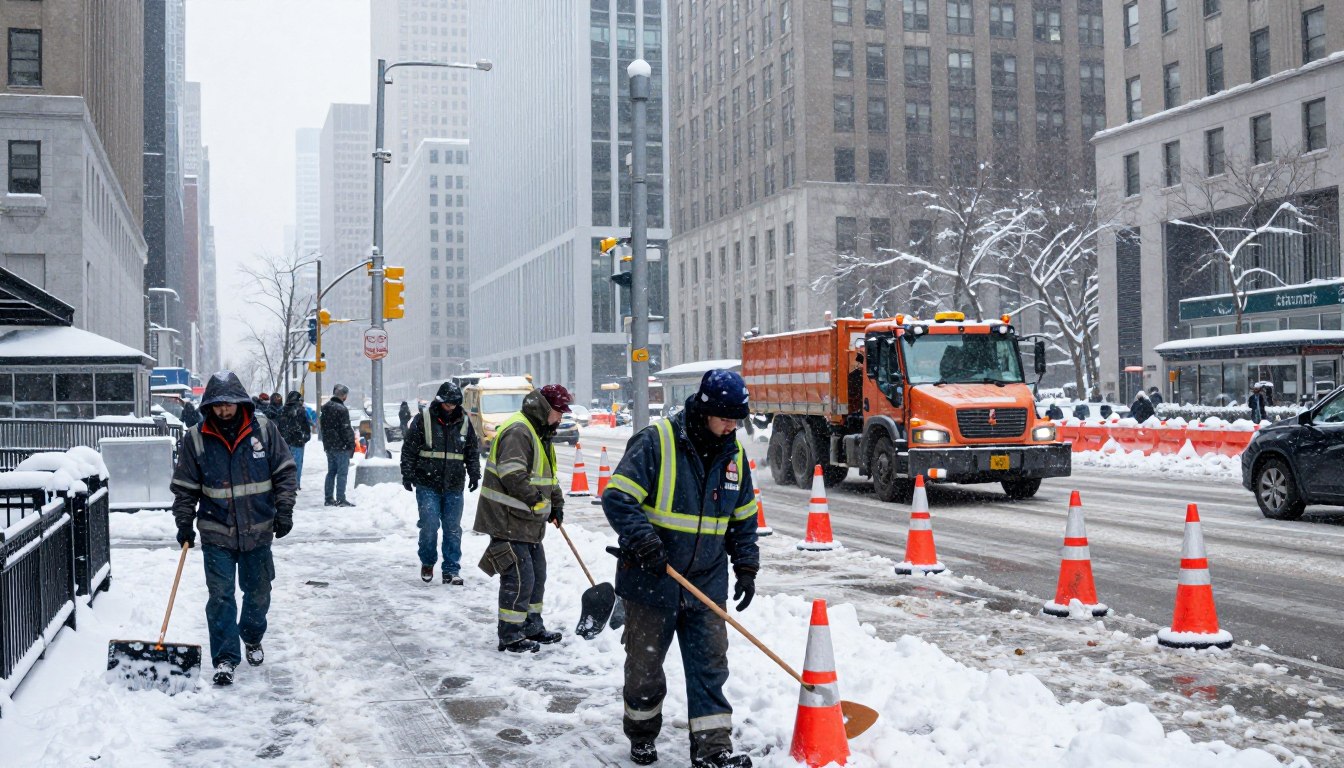
How Much Snow Did NYC Get? Latest Snowfall Totals
“In the midst of winter, I found there was, within me, an invincible summer.” That line from Albert Camus reminds us that even sharp weather can reveal strength and grit in our streets.
News reports showed this storm was set to be New York City’s largest in years, but totals shifted as bands moved and precipitation mixed with sleet and freezing rain.
Early Friday evening checks listed Central Park at 0.3″, LaGuardia at 0.1″, and JFK at 0.1″. Officials warned heavier bands could still arrive overnight, changing final readings and neighborhood results.

This article will give city-first totals, borough expectations, and broader Tri-State figures. It will note road and bridge impacts, airport delays, and municipal responses like DSNY plowing and OEM alerts. A timing recap (Friday start, overnight peak, Saturday taper) explains why accumulations varied across locations.
Key Takeaways
- Central Park, LaGuardia, and JFK offered quick official benchmarks for early totals.
- Forecasts changed mid-event as sleet and freezing rain reduced accumulation in spots.
- Roads, bridges, and airports saw rapid impacts that made this storm notable in the news.
- Expect city totals first, then borough and wider Tri-State comparisons in the full piece.
- Officials deployed plows, salt, and warnings; residents should follow cleanup and safety steps.
Latest NYC snowfall totals in inches
Nighttime readings at major observation points remained modest as the storm unfolded. Below are the latest reported totals, timestamped for quick reference.
- Central Park: 0.3″ (official city benchmark, as of 8 p.m)
- LaGuardia Airport: 0.1″ (useful for travelers; coastal influence may lower amounts)
- JFK Airport: 0.1″ (another traveler indicator that can differ from inland sites)
These three stations are standard reporting points for New York and york City totals because they give consistent, comparable readings across seasons. Central Park is the official benchmark used for historical records and citywide summaries, though it may not reflect every neighborhood.
Remember that snow totals capture the measured accumulation at a set location. They do not always show compaction, drifting, or wetting by sleet and freezing rain, all of which can reduce measured depth while still worsening travel.
All figures above are preliminary (as of 8 p.m.) and may be revised after heavier overnight bands or post-storm quality checks. Treat these as snapshot totals and check later updates for final storm numbers.
How much snow did NYC get compared with the forecast
By 8:23 p.m., the official forecast pivoted, trimming expected accumulations for much of the city. The National Weather Service revised the city outlook to 2–5 inches for New York City and northeast New Jersey.
National Weather Service update: reduced NYC totals
The NWS lowered earlier 5–9 inch projections after models showed warmer air mixing in. Reduced totals mean many measured amounts would fall below earlier higher ranges, though local pockets could still see more.
Why totals shifted: snow changing to sleet/freezing rain
When snow transitions to sleet or freezing rain, the measured accumulation drops. Ice and compacted slush can glaze streets even while official inch totals fall.
Where higher totals were still expected
Northern neighborhoods and northeast Queens remained candidates for higher accumulations due to colder pockets and storm banding. A later changeover or a brief heavy band overnight could still add inches before tapering by morning.
- Forecast vs. reality: early projections were scaled back as precipitation mixed.
- Practical impact: lower measured totals do not always mean safer roads—ice and wind matter.
- Local variance: borough-by-borough totals will reconcile citywide ranges with neighborhood results.
Timing recap of the winter storm in New York City
Friday afternoon marked the first flakes, and conditions shifted fast as evening fell.
When the event began
The system started Friday afternoon, with light precipitation reaching parts of the city before dusk. Temperatures stayed below freezing in many neighborhoods, so roads cooled and wet surfaces froze quickly.
Overnight peak and snowfall rates
Overnight, bands intensified. Forecasters reported brief bursts up to 1–2 inches per hour, which can reduce visibility to near-whiteout levels.
At those rates, untreated streets can become covered in 30–60 minutes, and untreated bridges ice over even faster. That level of intensity turns normal travel risky in a single hour.
When conditions tapered
By about 7 a.m. Saturday the main band eased. Tapering meant heavy bursts ended, but light snow or mixed precipitation lingered into midmorning.
“Tapering” did not mean a full stop; travel remained hazardous where slush and refreeze occurred. After several low-snow years, even this mid-range storm mattered for many neighborhoods.
| Time Window | What to Expect | Travel Impact |
|---|---|---|
| Friday afternoon–evening | Initial flakes, falling temps | Roads begin to slick; caution advised |
| Overnight peak | Bursts up to 1–2 in/hr; heavy bands | Low visibility, rapid coverage, impassable untreated surfaces |
| ~7 a.m. Saturday | Main band weakens; light snow possible | Conditions improve slowly; still hazardous during morning commute |
- Agency response: plows and salt crews deploy based on accumulation thresholds and peak timing.
- Travel note: the event coincided with a busy holiday weekend, increasing risk for unfamiliar drivers.
- Historical context: this was among the more notable winter events in recent years for parts of the city.
NYC borough-by-borough expectations and hot spots
Local banding and marine influence produced quick shifts in where snow piled up most across neighborhoods. Northern pockets and northeast Queens were singled out for the heaviest accumulations, while coastal corridors saw faster changeovers to sleet.
Heaviest bands and where accumulation stuck fastest
Cold inland corridors held flakes longer, letting accumulation stick in small windows. In those cold pockets, local bursts pushed totals up by the hour, adding visible inches on lawns and rooftops.
Lower totals in mixed-precipitation zones
Where sleet or freezing rain moved in, measured totals fell even as hazards rose. A thin glaze of ice bonded to walkways and made sidewalks slippery despite lower official numbers.
What to watch: band placement, overnight temperature drops, and the changeover line. These controlled whether a block saw quick accumulation or a heavy, icy coating.
Residents judging city ranges should focus on neighborhood reports. Plow priority and road treatment affect timing, so untreated streets turned snow-covered rapidly and remained a travel concern for many.
Tri-State area snowfall totals: Hudson Valley, Long Island, New Jersey, Connecticut
Storm reports beyond the five boroughs showed sharper contrasts as colder air and banding pushed totals up north and east.
Notable reports (about 8 p.m.): Somers, NY — 3 inches; Islip, NY — 1.9 inches; Bridgeport, CT — 2.2 inches. Heavier bands in the Hudson Valley already showed 4–7 inches on the ground in some spots.
Lower Hudson Valley and nearby suburbs
Elevation and a colder air mass favored higher totals north of the city. Local bursts stacked up quickly in the Lower Hudson Valley, giving suburbs several inches where the city stayed lighter.
Long Island and North Shore contrasts
Long Island saw mixed results. Islip was under 2 inches early, while forecast guidance showed potential for 6–11 inches in parts of the island.
North Shore pockets were singled out for the higher end of that range due to onshore banding and colder coastal pockets.
Connecticut and North Jersey notes
Bridgeport reported measurable accumulation as heavy bands pushed northeast. That shows the storm reached well into southern New England.
In North Jersey some locations transitioned to freezing rain and sleet. Ice reduced measured snowfall but raised travel and power-line risks across the state.
“A 6–11 inch corridor can still include smaller pockets that outperform forecast values when a band sets up,” meteorologists noted during the event.
| Region | Reported / Forecast inches | Primary Impact |
|---|---|---|
| Lower Hudson Valley | 3–7 in reported pockets | Higher accumulations; suburban roads slick |
| Long Island (North Shore) | 1.9 in reported; 6–11 in forecast | Heavy coastal banding; hazardous travel |
| Connecticut (Bridgeport) | 2.2 in reported | Snow extended into southern CT; commuter impacts |
| North Jersey | Mixed — snow to ice | Freezing rain increased crash and outage risk |
Practical takeaway: commuters between regions should expect variable road conditions. Even where inches were modest, ice or heavy bursts made major corridors slow and treacherous.
Long Island impacts: hazardous travel and local snow emergencies
Long Island officials urged residents to stay off roads overnight as bands tightened and visibility fell. The message prioritized safety: travel was to be limited to emergencies until crews could clear main routes.
Requests to stay off the roads overnight
Officials warned that brief bursts reduced sightlines and raised crash risk. Plows needed room to operate, and untreated surfaces iced quickly during the coldest hours.
Street-parking restrictions and towing risk
Multiple towns declared snow emergencies that banned street parking to keep lanes open. Vehicles left on routes faced ticketing and towing to allow uninterrupted plow passage.
Local budget readiness after low-snow years
Suffolk County said its reserves, built during several low-snow winters, let crews buy extra salt and staff overtime. That financial readiness supported longer, faster operations over the holiday period.
- Practical checklist for residents: adjust plans, charge phones, park legally, and monitor official alerts.
- Holiday note: more cars and visitors can worsen curbside congestion and slow plows.
| Action | Why it matters | What to expect |
|---|---|---|
| Stay off main and side streets | Keeps plows effective; reduces crashes | Faster clearing of priority routes |
| Move cars off streets | Prevents towing and narrows clearance | Avoid tickets; allow full plow width |
| Follow county alerts | Updates on timing and restrictions | Timely changes for residents and drivers |
New Jersey winter storm: snow to sleet to freezing rain
By Friday evening, rain and sleet were overtaking plain snow across swaths of New Jersey, creating a rapid icing threat.
State officials declared a state of emergency as the winter storm quickly changed phase. That alert meant extra coordination among plow fleets, utility crews, and emergency services.
Why conditions turned icy so fast
Sleet compacts into a hard, slick layer. Freezing rain then leaves a glaze that bonds to pavement, making surfaces treacherous when temperatures sit at or below freezing.
Result: measured snow could be low while hazards rose dramatically.
Near-whiteout conditions and spinouts during the commute
Heavy bands produced near-whiteout visibility and multiple spinouts during the Friday evening commute. Reports included incidents along Route 17 in East Rutherford.
These events showed the difference between a snowy but manageable road and an icy, dangerous corridor for drivers and transit agencies.
- Contrast with NYC: many New Jersey corridors changed to sleet/freezing rain sooner, raising icing risk faster than in the city.
- State of emergency effects: warnings to limit travel, staged resources, and prioritized treatment on key arteries and bridges.
- Commuter note: those moving between New Jersey and New York should expect stricter advisories in some NJ corridors.
| Impact | Why it mattered | Takeaway |
|---|---|---|
| Rapid changeover | Sleet/freezing rain increased icing | Treat routes as icy even with low measured totals |
| State of emergency | Expanded coordination and travel advisories | Stay off nonessential roads |
| Commute hazards | Near-whiteout and spinouts | Allow extra time or delay travel |
Next: regional road advisories explain when and where lanes were restricted and what drivers should watch for across the Tri-State area.
Road conditions and travel advisories across NYC and the region
Road surfaces froze quickly, leaving little time for melt and creating hazardous travel across the metro area.
Officials noted below-freezing ground temperatures meant flakes stuck at once. Untreated streets and side roads iced over fast, shortening the window when wet-pavement driving was possible.

Why untreated streets became snow-covered fast
Cold pavement was the core reason. When ground temps sat below freezing, even light precipitation bonded to asphalt instead of melting.
That effect made bridges and ramps especially dangerous; they lost heat faster and froze first.
Driver guidance as visibility fell
NYC’s Office of Emergency Management warned visibility could drop to one mile or less. Officials advised against nonessential travel Friday evening as conditions deteriorated rapidly.
- Reduce speed and increase following distance.
- Avoid sudden braking; use gentle stops and low gears on hills.
- Assume bridges and ramps freeze before main roads.
- Watch for whiteout-like bursts that hide lane markings and make lane changes risky.
| Risk factor | What happened | Practical tip | Timing |
|---|---|---|---|
| Cold ground | Immediate sticking to pavement | Delay travel until thorough clearing | Overnight peak |
| Reduced visibility | Bursts lowered sightlines to ≤1 mile | Pull off if conditions worsen; use hazard lights | During heavy bands |
| Regional variation | Short trips crossed from snow to sleet | Check conditions along the entire route | Commute windows |
| Treatment lag | Side streets stayed untreated longer | Use main arteries cleared first | First several hours after onset |
Commuter note: a brief drive across the area could move from light accumulation to heavier banding or mixed precipitation. That made planning and checking official updates essential.
Bottom line: treat roads as icy during the overnight peak and follow official advisories. Conditions changed fast; monitor city and state alerts before heading out.
Bridge and highway disruptions: closures, restrictions, and reopenings
A 90-minute closure on the Queensboro Bridge upper level disrupted cross-river traffic when ice formed rapidly. The upper lanes were shut while crews treated the surface and checked safety before the deck reopened to vehicles.
Queensboro Bridge upper-level lane closure due to ice
Why it closed: ice on the span created immediate slip risks for cars and motorcycles. Bridges lose heat faster than adjacent streets, so even when nearby roads looked slushy or wet, the bridge surface iced over first.
New Jersey commercial vehicle bans on major interstates
New Jersey placed commercial vehicle restrictions on several routes to reduce crash risk and ease traffic flow. The affected corridors included I-78, I-80, I-280, I-287, and Route 440.
When restrictions were lifted and what drivers should expect
Officials lifted the bans at 8 a.m. Saturday, but they warned that roads remained wet and slippery. Lifted restrictions did not mean all hazards were gone.
- Expect lingering slick spots on ramps and shoulders.
- Travel times may stay slower while plows and salt trucks finish work.
- Reduced traction can persist on bridges and shaded stretches for the rest of the day.
| Disruption | Action taken | Timing / Status |
|---|---|---|
| Queensboro Bridge (upper level) | Upper lanes closed for treatment due to ice | Closed ~90 minutes; reopened after inspection |
| New Jersey commercial vehicles | Bans on major interstates and Route 440 | Restrictions lifted at 8 a.m. Saturday; caution advised |
| General driver expectations | Plows active; lanes reopen gradually | Slower travel and residual slick spots through the day |
News updates noted these measures were preventative. Closures and bans aimed to reduce crashes during peak icing and near-whiteout bursts, not only to limit congestion.
Flight delays and cancellations at NYC-area airports
Flight operations at the region’s airports slowed sharply as crews worked through extended de-icing lines and repeated runway clearing cycles.
Reported disruption counts during the event showed heavy impacts across hubs.
Newark Liberty
Delays: 321 • Cancellations: 249. Newark faced long gate holds while crews repositioned aircraft and crews.
LaGuardia
Delays: 170 • Cancellations: 250. LGA saw high cancel totals even as runway crews cycled treatment runs.
JFK
Delays: 279 • Cancellations: 387. JFK’s heavy cancel count reflected backlog and aircraft de-icing queues.
Why moderate inches of accumulation can still cripple service: runway clearing, gate access, crew rest limits, and de-icing all add delays. Morning departures were especially vulnerable as airports dug out and reset schedules while light snow lingered.
Traveler tips: recheck airline apps often, expect rebooking lines, and allow extra time for ground travel given road conditions. Disruptions in one hub ripple through the wider area network and affect connecting itineraries.
| Airport | Delays | Cancellations |
|---|---|---|
| Newark Liberty | 321 | 249 |
| LaGuardia | 170 | 250 |
| JFK | 279 | 387 |
City response: plows, salt, and DSNY operations
DSNY began staged operations before midnight with liquid brine applied to highways, ramps, and bridge approaches. Acting Commissioner Javier Lojan confirmed crews used brine to prevent early bonding and to aid later clearing.
Brine pre-treatment and salt spreader deployment
Brine was sprayed at midnight on priority corridors. Salt spreaders hit major streets as accumulation started, then worked into smaller residential blocks.
When plows roll out (accumulation thresholds)
Plows were set to deploy broadly once about 2 inches accumulated. That operational trigger explains why some neighborhood roads saw treatment later in the night.
How to use the NYC live plow tracker by address
To check progress:
- Open the NYC plow tracker on the city site and enter your address.
- Watch the map for shaded streets marked as plowed or queued.
- Refresh occasionally; the map updates as crews log activity.
“Our priority routes support buses, ambulances, and hospital access; faster clearing on those streets saves lives and speeds recovery into the morning,” DSNY officials said.
| Action | When | Result |
|---|---|---|
| Brine pre-treatment | Midnight | Reduces bonding of snow/ice to pavement |
| Salt spreaders | As accumulation begins | Improves traction on main and side streets |
| Plow deployment | ~2 in accumulation | Clears priority routes; then local streets |
Public safety measures in New York City
City officials moved quickly to warn the public as visibility fell and untreated streets turned slick.

Rapid deterioration: OEM warnings
The Office of Emergency Management told residents Friday afternoon that visibility could drop to about one mile or less.
Officials warned that untreated roads would become snow covered fast and that travel was not recommended during the highest-risk window.
Code Blue protections
Code Blue went into effect when overnight temps were forecast below 32°F. Shelters must accept people in need during these conditions.
This measure helps protect those experiencing homelessness and coordinates outreach teams to provide warm spots and transport.
Home and pedestrian safety reminders
City messaging stressed basic safety: do not use ovens to heat apartments and avoid unvented combustion devices that risk fire or carbon monoxide.
Pedestrians face sharp risks from hidden ice patches, slick stairs, and unshoveled corners—injuries often rise even when totals stay modest.
- Treat sidewalks and side streets as potentially icy after precipitation lightens.
- Keep portable CO detectors and follow safe-heating guidance indoors.
- Delay nonessential travel while plows and salt crews work priority routes.
“Follow official alerts and stay off the road when advisories ask you to; those steps reduce strain on emergency responders and cut crash risk.”
| Measure | Why it matters | Action |
|---|---|---|
| OEM warning | Rapid visibility drop; slick surfaces | Avoid travel during peak |
| Code Blue | Protects people without shelter | Shelters open; outreach active |
| Home safety | Fire/CO risks rise with unsafe heating | Use approved heating; ventilate |
Next: these public warnings, Code Blue, and operational readiness feed directly into official emergency declarations and resource staging described in the following section.
States of emergency and official statements
Officials declared emergency measures so agencies could mobilize equipment and crews without delay.
New York State declaration and resources on standby
Gov. Kathy Hochul issued a State of Emergency before the event. The order freed up personnel, pre-positioned equipment, and sped permit processes for rapid response.
Her guidance: avoid nonessential travel, use extreme caution on roads, and monitor local alerts so crews can work safely and efficiently.
Mayoral update and city accumulation ranges
Mayor Eric Adams cited a forecast of 6–9 inches citywide, with up to 11 inches possible in northeast Queens and some northern neighborhoods. Officials used a range to reflect banding and mixed precipitation that change totals block by block.
County-level declarations in Westchester and Nassau
Westchester and Nassau declared states of emergency to coordinate public works, clear roads, and stage mutual aid. Executives cited hazardous conditions and pockets that could exceed 10 inches in parts of their counties.
“Declarations focused on faster mobilization and public safety as conditions evolved,” officials said.
| Authority | Action | Primary goal |
|---|---|---|
| State | Emergency declared | Free resources; speed response |
| City | Forecast briefings | Guide travel decisions |
| Counties | Local emergencies | Coordinate plows and aid |
After several low-snow years, leaders treated this event as operationally significant even as totals varied. That stance aimed to keep residents safe and services moving during a fast-changing weather situation covered in the latest news.
Power outage concerns and utility readiness
Even modest accumulations can cause outages when wind and ice add weight to trees near power lines. That combination is the main reason utilities warn residents before a winter storm.
Why heavy loading and wind raise outage risk
Main mechanisms: heavy, wet accumulation loads branches and wires. Wind adds stress and can snap weakened limbs. Ice forms a hard, heavy coating that makes breakage more likely.
Staged crews and what “staged” means
Gov. Hochul said the state had over 5,000 utility crews ready for deployment. Staged means crews and equipment are positioned regionally to respond quickly as outages are reported.
- Crews repair downed conductors, clear fallen trees, and restore service lines.
- Mutual-aid teams may travel between counties or states if damage is concentrated.
Practical guidance for residents
Keep phones charged and have flashlights and extra batteries handy. Know your local utility outage number or app and report service interruptions promptly.
Outage risk can persist after precipitation ends if winds rise or ice stays on limbs. For an area with relatively low totals in recent years, preparedness matters—damage can happen even when measured depth looks modest.
Restoration note: repair and hazard removal often continue into the day after the storm, so expect crews to work through recovery in affected neighborhoods.
| Risk Factor | What Utilities Do | Resident Action |
|---|---|---|
| Wet accumulation on limbs | Priority tree clearance; line repairs | Report downed lines; keep clear distance |
| Wind stress | Pre-position crews; traffic and safety coordination | Secure outdoor items; avoid travel near damaged trees |
| Ice on lines | Specialized crews and equipment; staged mutual aid | Have emergency kit; check neighbors for help |
| Post-storm persistence | Extended patrols and follow-up repairs | Expect intermittent restoration timelines |
Cleanup and recovery: shovelers, parking rules, and what residents can do next
By dawn the priority shifted to clearing public access points and making routes passable for the morning commute. The city is balancing organized removal with safety steps for people on foot and behind the wheel.
Emergency shoveler hiring and deployment
NYC is hiring emergency snow shovelers to clear bus stops, crosswalks, and other public spaces. Pay starts at $19.14/hour and rises to $28.71/hour after 40 hours in a week.
Applicants must be at least 18 and eligible to work in the U.S. Crews are sent to high-foot-traffic spots first to restore safe access for transit riders and pedestrians.
Alternate side parking suspension and why it matters
The city suspended alternate side parking on Saturday to speed curb-to-curb clearing. Fewer parked cars let plows cut closer to the curb and remove more slush in a single pass.
What residents should do: avoid blocking routes, move cars when directed, and give crews space to work for faster cleanup.
Post-storm hazards and safety tips
Refreeze overnight can form black ice on shaded blocks and leave slushy intersections that harden by the next day. Treat sidewalks and stairs as potentially icy.
- Shovel in layers to avoid strain and clear down to pavement when safe.
- Use salt or sand sparingly to improve traction near doors and steps.
- Check on neighbors, especially older adults, and keep walkways clear around buildings.
Travel and the holiday weekend
Even after restrictions lift, roads can remain wet and slippery. Allow extra time for holiday travel and drive cautiously while crews finish treatment.
Immediate priorities are clearing sidewalks, protecting vulnerable residents, and keeping plow lanes open so recovery can proceed quickly and safely.
Conclusion
Central Park and airport benchmarks provided the most reliable snapshot of city totals. Local reports filled in neighborhood differences after bands shifted overnight.
The forecast changed as sleet and freezing rain mixed in, cutting measured snowfall even while hazards rose. Measured snow depth fell in some spots but icy streets and bridge closures increased risk.
Timing mattered: Friday afternoon/evening onset, an overnight peak of heavy bursts, and a Saturday morning taper framed when accumulations happened and crews worked.
Across the region, parts of new york and nearby towns saw heavier bands and higher readings than many blocks in new york city.
Keep monitoring local updates, expect slick spots and refreeze, and use city and state tools for recovery and travel decisions as conditions normalize.
FAQ
What were the official snowfall totals at Central Park, LaGuardia and JFK?
The National Weather Service and local observation stations reported Central Park as the city benchmark, LaGuardia Airport with its own official traceable total, and JFK with a separate airport-measured amount. Central Park and the two airports provided the primary citywide references used by city agencies and news outlets when issuing updates.
Did reported totals change from the initial forecast?
Yes. The NWS issued updates lowering expected accumulations for many neighborhoods after precipitation transitioned to sleet and freezing rain across parts of the metropolitan area. That shift reduced final accumulation compared with earlier model projections.
Where in the city did higher totals remain likely?
Northern neighborhoods, northeast Queens and some higher-elevation pockets held the best chance for heavier bands. Those areas saw colder air and steadier snow during peak storm hours, preserving higher accumulations than much of the five boroughs.
When did the storm begin and when did it reach peak intensity?
Snow began in the Friday afternoon into evening window, with overnight hours producing the highest rates. At times, snowfall rates approached 1 to 2 inches per hour before tapering off into Saturday morning as the system pulled away.
Which boroughs recorded the heaviest bands and fastest accumulation?
The heaviest bands coated parts of the Bronx, Queens’ northeast sections and northern Brooklyn. Those corridors experienced the quickest accumulation where the snowfall remained all snow rather than mixing with sleet or freezing rain.
Why did some neighborhoods see much lower totals?
Mixed precipitation zones, where snow switched to sleet or freezing rain, produced lower measured accumulations. Urban heat and coastal influences around southern Brooklyn and lower Manhattan also limited sticking in some places.
How did totals in the Hudson Valley, Long Island, New Jersey and Connecticut compare?
The Lower Hudson Valley reported generally lower amounts near the city, while heavier bands developed farther north. Long Island showed a gradient, with higher North Shore totals. Connecticut saw varied amounts depending on inland versus coastal exposure. In North Jersey, some areas reported significant ice impacts alongside snowfall.
What travel warnings and local rules did Long Island authorities issue?
Officials urged residents to avoid travel overnight during the storm, activated street-parking restrictions in affected towns, and warned of towing for improperly parked cars. Local agencies emphasized readiness after several light-snow seasons.
Why did New Jersey shift from snow to sleet and freezing rain so quickly?
A warm layer aloft combined with cold surface air created vertical temperature profiles favorable to sleet and freezing rain. That thermal setup led authorities to declare emergencies and to anticipate hazardous icy roads despite initial snow forecasts.
How did road and visibility conditions evolve during the event?
Below-freezing surface temperatures allowed untreated roads to become snow- and ice-covered fast. Visibility dropped in heavy bands, creating whiteout-like conditions on some stretches and prompting travel advisories from state and city officials.
Were bridges and highways closed or restricted?
Several structures faced temporary restrictions due to ice buildup, including lane closures on elevated spans and commercial vehicle bans on major interstates in New Jersey. Authorities lifted some limits as conditions improved and crews applied salt and anti-icing treatments.
What was the impact on flights at Newark, LaGuardia and JFK?
All three hubs experienced delays and cancellations tied to winter weather operations, deicing needs and air-traffic flow constraints. Newark reported significant schedule disruptions, with LaGuardia and JFK also affected based on peak storm timing and runway conditions.
How did the City deploy plows, brine and salt during the storm?
The Department of Sanitation pre-treated many routes with brine and put salt spreaders and plows into motion once accumulation thresholds were met. Plow deployment priorities focused on major arteries, transit routes and emergency corridors, with live plow-tracker tools available to the public.
What public-safety actions did New York City announce?
The Office of Emergency Management sent warnings about rapid deteriorations. Code Blue and shelter measures were activated to protect people experiencing homelessness, and officials issued home-safety reminders about heating and generator use during winter storms.
Were any states of emergency declared and by whom?
New York State and several counties, including Westchester and Nassau, issued declarations to mobilize resources and streamline response. The mayor’s office provided citywide accumulation ranges and operational updates while state resources stood on standby.
How did utilities prepare for possible outages?
Utilities staged crews in anticipation of wind-driven trees and heavy ice that can down lines. Providers described the number of crews positioned regionally and outlined restoration priorities for critical infrastructure and large customer outages.
What should residents expect during cleanup and recovery?
Residents can expect alternate-side parking suspensions in many areas to aid removal, available shoveling jobs with posted pay rates, and post-storm hazards such as refreeze on sidewalks and wet, slippery streets that require caution for several days after the event.