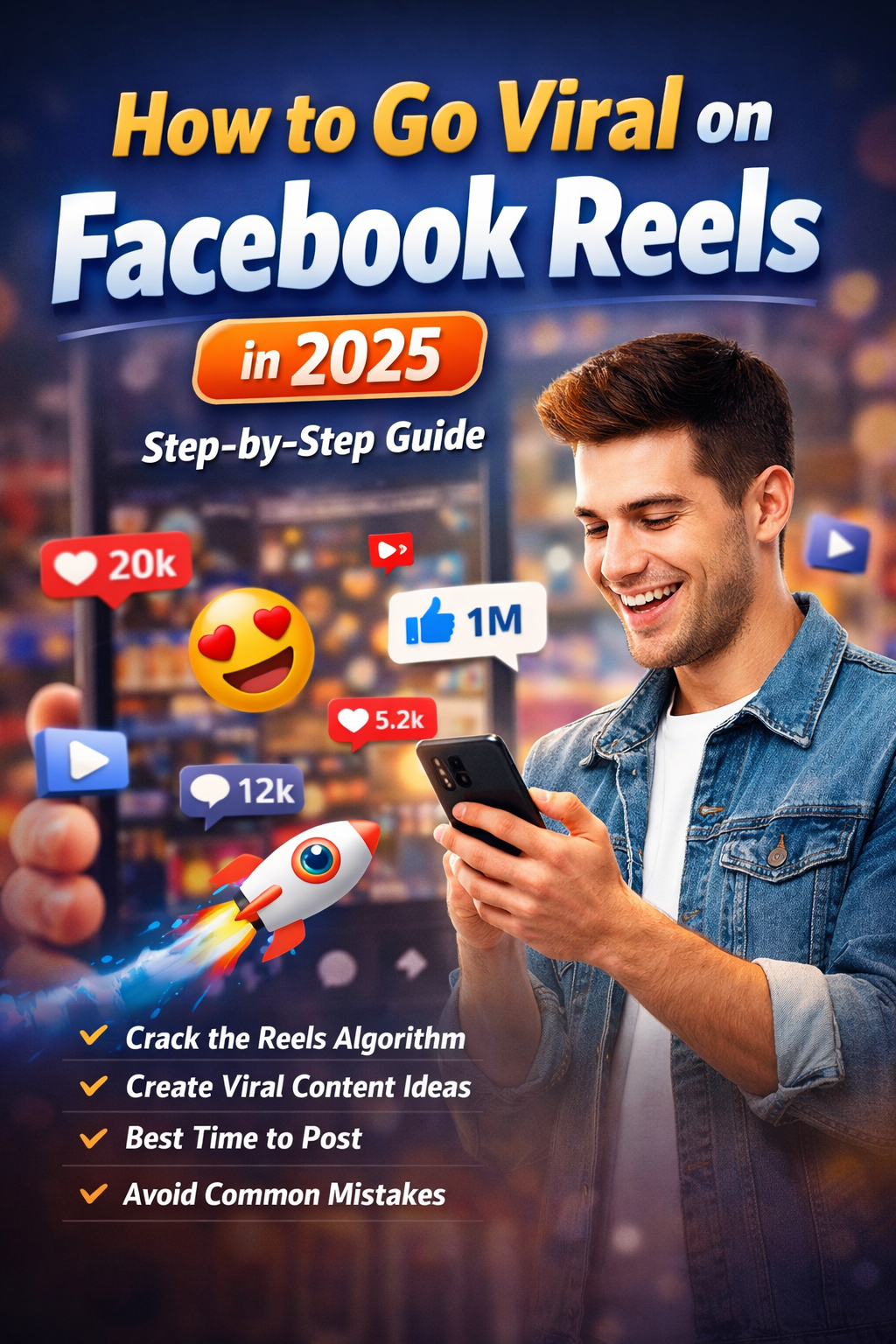
How to Go Viral on Facebook Reels: A Complete Step-by-Step Guide That Actually Works in 2025
Facebook Reels is no longer just a feature—it is one of the strongest organic growth tools available today. In 2025, Facebook is pushing Reels harder than ever to compete with TikTok and YouTube Shorts. This means one thing for creators, bloggers, and marketers: massive organic reach is still possible.
But there is a problem.
Most people post Facebook Reels every day and still get:
- 0 views
- 100–300 views
- No engagement
- No growth
So the real question is:
How to go viral on Facebook Reels consistently, not by luck?
This in-depth guide answers that question with real strategy, algorithm logic, and actionable steps that work for beginners and experienced creators alike.
What Does “Going Viral” on Facebook Reels Really Mean?
Before learning how to go viral on Facebook Reels, you need to understand what “viral” actually means in Facebook’s system.
A Facebook Reel is considered viral when:
- It reaches people who do not follow you
- It gets 10× to 100× more views than your follower count
- Facebook continues pushing it for 24–72 hours or more
- Engagement (watch time, shares, comments) keeps increasing naturally
Viral does not always mean millions of views.
For a new page, even 20,000–50,000 organic views is viral.
How the Facebook Reels Algorithm Works (Most Important Section)
If you don’t understand the algorithm, no strategy will work.
Facebook Reels ranking is driven by user behavior, not hashtags or posting tricks.
1. Watch Time (The #1 Ranking Factor)
Facebook measures:
- How long users watch your Reel
- Whether they watch it till the end
- Whether they replay it
If users stop watching in the first 2–3 seconds, Facebook stops distributing the Reel.
👉 Higher watch time = higher reach
2. Completion Rate
A short Reel that is watched fully performs better than a long Reel that people abandon halfway.
That’s why short, focused Reels go viral more often.
3. Engagement Quality
Facebook values engagement in this order:
- Shares (most powerful)
- Comments
- Saves
- Likes
A Reel with fewer likes but more shares will outperform a Reel with many likes and no shares.
4. Original Content Detection
Facebook can detect:
- TikTok watermarks
- Re-uploaded content
- Low-effort reposts
Original editing and formatting increases trust.
5. Account Consistency & Trust
Facebook tests new accounts.
Accounts that post consistently build algorithm trust faster.
Step 1: Choose the Right Niche to Go Viral Faster
Not all niches have equal viral potential.
High-Performing Facebook Reels Niches in 2025
- Motivation & mindset
- Psychology & human behavior
- AI tools & tech hacks
- Short funny clips
- Travel moments
- Animals & nature
- Before/after transformations
- Facts, mysteries, and “did you know” content
If your niche already has viral Reels, that’s a good sign.
Step 2: Master the First 3 Seconds (Hook Strategy)
The first 3 seconds decide everything.
Weak Hook ❌
“Today I want to talk about…”
Strong Hook ✅
- “Facebook doesn’t want you to know this…”
- “This mistake is killing your Reels reach…”
- “Watch this before posting another Reel…”
Your hook must:
- Stop scrolling
- Create curiosity
- Promise value
This is a core principle of how to go viral on Facebook Reels.
Step 3: Ideal Length for Viral Facebook Reels
Based on performance data:
- 6–10 seconds → Highest viral potential
- 11–20 seconds → Educational + good reach
- 30+ seconds → Low virality (unless storytelling is excellent)
Shorter Reels = higher completion rate = more reach.
Step 4: Use On-Screen Text the Right Way
Most Facebook users watch Reels without sound.
Always use:
- Large readable text
- High contrast colors
- Short sentences
- One idea per screen
Example:
“This is why your Facebook Reels get no views”
Step 5: Best Posting Time for Facebook Reels
There is no universal time, but these time windows work globally:
- 6:00 AM – 9:00 AM
- 12:00 PM – 2:00 PM
- 7:00 PM – 10:00 PM
Post at the same time daily for at least 7 days to train the algorithm.
Step 6: Hashtag Strategy That Actually Works
Hashtags help Facebook understand your content category, not make it viral.
Best Practice
- Use 3–5 hashtags
- Mix broad + niche hashtags
Example:
#facebookreels
#reelsgrowth
#viralcontent
#socialmediatips
Avoid hashtag stuffing—it hurts reach.
Step 7: Caption Strategy for Higher Engagement
Your caption should not describe the video.
It should create interaction.
High-Engagement Caption Formula
- Curiosity sentence
- Question
- Soft call-to-action
Example:
“This small change doubled my reach. Did you know this?”
Comments boost distribution.
Step 8: Consistency Strategy That Builds Viral Momentum
Most creators quit too early.
Proven Posting Plan
- 1–2 Reels per day (best)
- Minimum: 1 Reel daily
- Commit for 30 days
Many Reels go viral days or even weeks later.
Never delete underperforming Reels.
Common Mistakes That Kill Facebook Reels Reach
Avoid these completely:
- TikTok watermark
- Long boring intros
- Low-quality blurry videos
- Copy-paste captions
- Hashtag stuffing
- Reposting the same Reel repeatedly
How Long Does It Take to Go Viral on Facebook Reels?
There is no fixed timeline.
Typical patterns:
- 24–48 hours → Fast viral
- 7–14 days → Delayed push
- 30+ days → Algorithm re-test
Patience is part of learning how to go viral on Facebook Reels.
Monetization After Going Viral
Virality without strategy is wasted traffic.
You can monetize through:
- Facebook In-Stream Ads
- Affiliate marketing
- Website traffic
- Brand collaborations
- Digital products
Always plan monetization before chasing views.
Why Facebook Reels Is Still Worth It in 2025
Facebook is heavily investing in Reels because:
- It competes with TikTok & YouTube Shorts
- It increases time spent on the platform
- It attracts creators with monetization options
Organic reach is still alive—if you follow the right system.
Final Thoughts
Learning how to go viral on Facebook Reels is not about luck, trends, or copying others. It is about:
- Understanding the algorithm
- Creating scroll-stopping hooks
- Maximizing watch time
- Posting consistently
- Avoiding common mistakes
If you apply this strategy properly, viral growth becomes predictable, not accidental.